Before the internet existed, a massive network already connected the world: AT&T’s analog
phone system. It used audible audio tones to control its own long-distance calls,
and that turned out to be its greatest weakness.
A group of curious teenagers, blind kids and amateur engineers discovered that, with the right
whistle, they could travel the network like ghosts. Five decades later, the ghosts changed
instruments, but they’re still circulating.
▸ TL;DR · WHAT YOU’LL LEARN
How a blind 7-year-old cracked AT&T’s vault by whistling.
Why the SMS scam ring dismantled in São Paulo in 2024 runs on, at its core, the same idea from 1957.
What changes when the network stops being analog and the ghosts trade the whistle for a US$ 500 SDR.
Until the 1990s, the global phone system was dominated by AT&T and its
national counterparts. It was the largest engineering project of the 20th century before
the internet: a network of electromechanical switches (later electronic, with the ESS,
Electronic Switching Systems) covering entire continents over copper wire and
relay-based central offices.
The defining feature, and the fatal flaw, was in-band
signaling: the commands that controlled a call (set up, tear down, route) were
audio tones transmitted on the same frequency band as the human voice. The switch
had no separate control channel; it listened to the same wire that carried your conversation.
An idle long-distance trunk continuously emitted a 2600 Hz tone. When
someone placed a call, the tone stopped, signaling “line in use”. When the call ended, the
tone returned, signaling “trunk free, next customer please”. The consequence was simple and
devastating: if you could generate 2600 Hz into the receiver, the switch believed your
call had ended, without you hanging up.
AT&T published all the technical details in the Bell System Technical
Journal (November 1960, “Signaling Systems for Control of Telephone
Switching”). The assumption was naive but honest: no ordinary customer would own a
calibrated tone generator, and Bell engineers were trustworthy men. It took one generation
to turn that trust into a billion-dollar hole.
Josef
Carl Engressia Jr., born May 25, 1949 in Richmond, Virginia, was the first
phreaker recorded by history. He was born blind and had absolute pitch.
By age 4 he already spent hours on the phone. He soon grew fascinated by the thousands
of distinct tones the network produced, and started listening to them for hours every day.
2600 Hz wasn’t a common tone on regular calls; he only began to hear it after spending
long stretches with the phone off the hook, listening to the silence of the idle
long-distance trunk. When he recognized that specific tone, he started whistling it back:
he didn’t yet know what it did, but he knew it was a valid system signal. He had found
2600 Hz at age 7, in 1957, thirteen years before Captain Crunch and the
cereal whistle. Even before the whistle, still a kid, Joe found he could replicate
rotary-dial pulses with the hookswitch and bypass the lock his babysitter clamped on the
phone: the first practical record of tap dialing.
▸ WHAT IS ABSOLUTE PITCH?
A rare ability (estimated at 1 in 10,000 people) to identify and reproduce any musical
note without a reference. Someone with absolute pitch hears a sound and knows
immediately whether it’s A-440Hz, E-330Hz or G#-415Hz, the same way most people
recognize colors. Joybubbles’ gift was even rarer: he could whistle any
specific frequency on demand, with just a few hertz of variation. For a phone system that
controlled calls with calibrated tones, that was handing him the keys to the vault.
In 1968, a student at the University of South Florida, Joe was the subject
of a campus newspaper article that nicknamed him “The Whistler”. AT&T sued the
university. In 1971, Ron Rosenbaum interviewed him for the Esquire piece
“Secrets of the Little Blue Box”,
the same text that would inspire
Steve Wozniak
to build the first Blue Box.
Joe never used his skills for fraud: he wanted to understand the network. In 1975,
after years of friction with the FBI, he was hired by Mountain Bell in
Denver as a network troubleshooter, a role he held for seven years until moving to
Minneapolis in 1982. In May 1988 he “reverted to childhood” as a way to process sexual
abuse he had suffered as a child, declaring himself permanently 5 years old. In 1991, he
formalized the change in court and legally adopted the name
“Joybubbles”. He died on August 8, 2007 in
Minneapolis of congestive heart failure. Worth listening to NPR’s obituary:
“Joe
Engressia, Expert ‘Phone Phreak,’ Dies” (2007).
▸ JOYBUBBLES WAS NOT AN ANOMALY · THE BLIND PHREAKER COMMUNITY
Popular literature treated Joe as a genius outlier, but Phil Lapsley in
Exploding the Phone
(2013) maps out an entire community: Bill Acker (New York),
Roy Bates and Denny Teresi (California), all blind,
all sharp-eared, all discovering the phone network as a social space at a time when
conference lines and idle trunks were accessibility before the term existed.
Anyone with free time, a phone against the ear and above-average pitch perception lived
phreaking as routine, not feat. Joybubbles was the public face of an invisible network.
The oldest phreaking technique used no special tones or whistles, just a well-trained
finger. Called tapping or switch-hook dialing, it turned
the phone’s hookswitch into an improvised dial. Joybubbles learned the trick as a
kid, before he ever discovered the magic whistle.
To understand why the trick works, it helps to see what it was imitating: the rotary
dial telephone (alongside). Each digit spun the disk to a finger stop; on its way
back, an internal cam rotated and its teeth struck a copper pawl, generating the
electrical pulses the switch counted.
ROTARY_DIAL_v1.0○ READY
click a digit
The disk and the cam spin together on the same shaft. On release, the cam returns and each tooth strikes the copper pawl, generating one electrical pulse to the switch.
How tapping beats the dial
Dialing “5” meant sending 5 pulses at a cadence of 10 pulses per second
(60ms open / 40ms closed). Phreakers found the shortcut: tapping the hookswitch
repeatedly opens and closes the same circuit. Same logic as the dial, no dial
needed. Phones with a locked rotary? Bypass via hookswitch. Hotel payphones with no
dial? Tap the hook. It was the most democratic trick in phreaking, any finger learned
it in half an hour.
▸ HOW IT WORKED
Pick up the phone (line closed → dial tone)
To dial “3”, tap the hookswitch 3 times (~60ms each)
Wait ~700ms, the switch registers “3”
Repeat for the other digits. “0” is 10 taps.
Cadence: 40/60 (Bell) vs 33/67 (CCITT/Telebrás)
The numbers above describe the Bell US cadence: each pulse is
60 ms break / 40 ms make (60% circuit open, 40%
closed), at 10 PPS. Under the CCITT standard that Telebrás (the
Brazilian state telecom monopoly) inherited in 1968, the ratio is different:
67 ms break / 33 ms make. Same frequency (10 pulses
per second), different internal distribution.
In practice, a trained finger could fool any switch, because relays had wide
tolerance for deviation. But the difference explains why imported blue boxes and
dialers had to be recalibrated for Brazil, and why BR phreakers ended up designing
their own circuits instead of cloning American schematics without adjustment.
▸ POP CULTURE
The classic scene of a prisoner who needs to make a forbidden call, hangs up the
prison payphone and taps the hookswitch to dial a number off the approved
list, is a direct reference to this technique. It shows up in
Hackers (1995),
in WarGames (1983),
and in a dozen prison thrillers from the 80s and 90s. It wasn’t a screenwriter’s
invention: it was the only thing that actually worked on a phone with a locked dial.
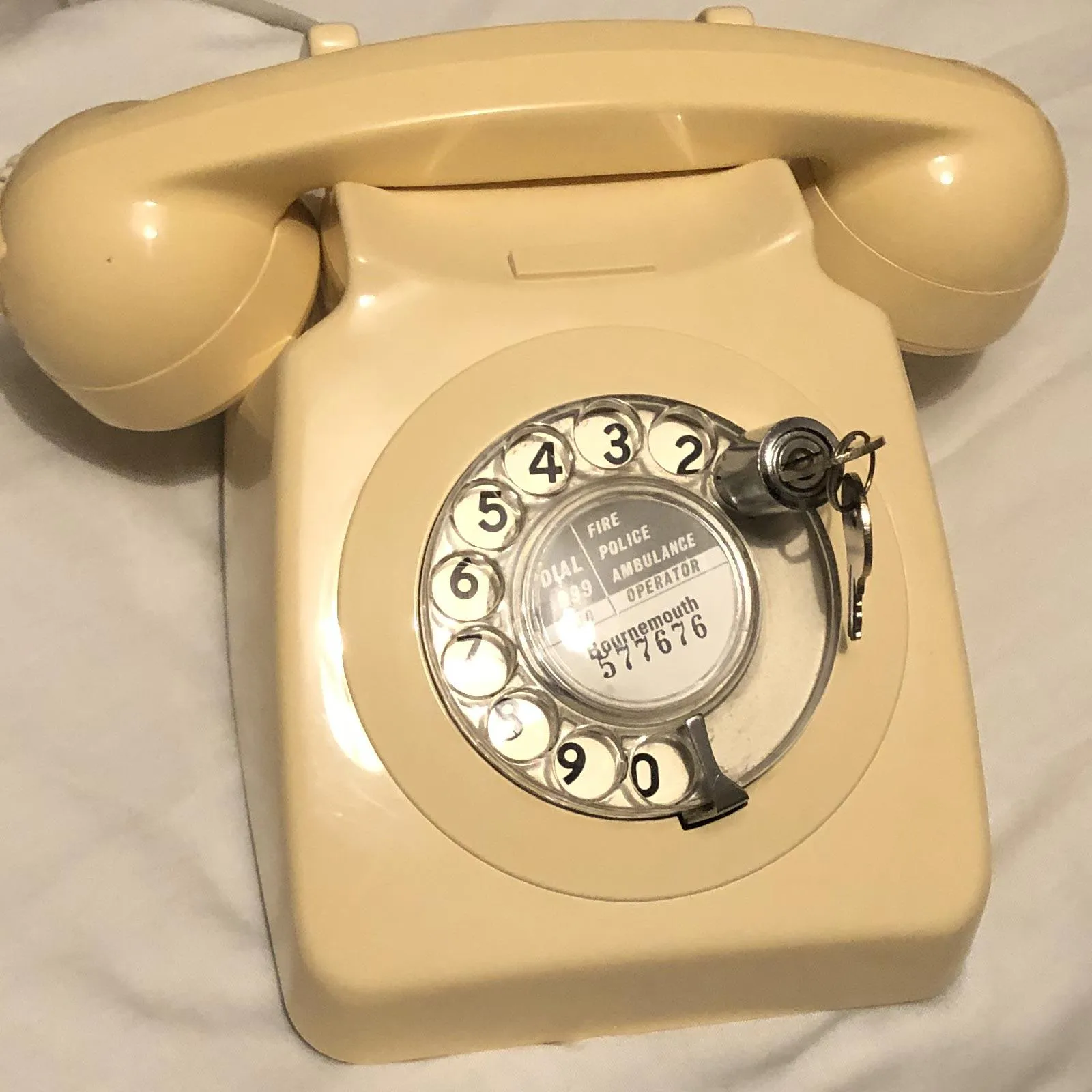
The exact scenario where tapping was the only way out: a physical padlock threaded through the dial, blocking ordinary dialing.
PULSE_DIALER_v1.0○ STANDBY
DIALED
_
hookswitch prongs · drop on every tap, opening the circuit
CLOSEDOPEN
PULSES0
RATE—pps
1 tap = 1 • 5 taps = 5 • 10 taps = 0 • 700ms gap between digits
Joybubbles was the first to notice, but not the only one. In 1968, engineer
John Draper
met a blind sailor who gave him the tip: the plastic toy whistle that came as a prize
in Cap’n Crunch
cereal played exactly 2600 Hz. Blow it into the mouthpiece and the long-distance trunk
surrendered. The world got a Captain Crunch; AT&T lost control.
When the whistle hit the receiver, the switch believed the call had ended, but the line
stayed open. You were still connected to a live long-distance trunk, only now as if
you were the switch yourself, free to issue direct commands.
▸ HOW IT WORKED
Dial a 0800 number (free, but uses a long-distance trunk)
After connection, blow 2600 Hz into the mouthpiece
The remote office disconnects the destination but keeps the trunk
You now have direct access to the trunk network
OSCILLOSCOPE_v2.1 ○ STANDBY
NOTEA4FREQ_HZ440 Hz
10020004000
CALL_ROUTE
HANDSET
LOCAL_OFFICE
TRUNK_2600
INTERNATIONAL
⚡ TRUNK SEIZURE DETECTED — INTERNATIONAL BACKBONE ACCESS GRANTED
Once the 2600 Hz whistle “opened” the trunk, you had to tell the network where to
dial. AT&T used a signaling system called CCITT5 / Multi-Frequency (MF):
each digit is represented by two simultaneous tones, picked from a matrix of
6 frequencies (700, 900, 1100, 1300, 1500, 1700 Hz).
The Blue Box, popularized by
Steve Wozniak
and Steve Jobs
before they founded Apple, was a device that generated those tone pairs. Ron Rosenbaum’s
article “Secrets of the Little Blue Box”,
published in Esquire in 1971, exploded the popularity of the hobby.
▸ BEFORE YOU PLAY: KP AND ST
On top of the 10 digits, the MF protocol carries two control tones that tell
the remote switch when an address starts and ends. Without them, the digit sequence is
just noise.
• KP (Key Pulse, tones
1100 + 1700 Hz) opens the packet: it says
“heads up, digits are coming”. Always the first tone sent.
• ST (Start, tones
1500 + 1700 Hz) closes the packet: “I’m done, you
can route now”. Always the last.
The full sequence for a call is KP · digits · ST. In the
simulator below, start with KP, dial the destination digits, and finish with ST.
BLUE BOX // MOD-1971
AWAITING SEIZE_
▸ CCITT5_MATRIX.dat
700
900
1100
1300
1500
900
1
1100
2
3
1300
4
5
6
1500
7
8
9
0
1700
KP
ST
■ digit■ command
▸ SIGNAL_LOG.txt
Awaiting commands...
[1] Press "EMIT 2600 Hz" to seize trunk
[2] Use KP + digits + ST to route call
Example: KP 1 8 0 0 5 5 5 1 2 1 2 ST
(international route)
But Brazil was different: R2/MFC 5C
While AT&T, BT and European carriers ran CCITT5 with in-band MF tones, in 1968 Brazil
adopted the R2/MFC variant 5C signaling.
The difference is architectural, not cosmetic: in R2, MF tones move between
registers (sender/receiver only allocated during setup), never on the voice
channel. Supervision runs at 3825 Hz out-of-band, above the
PCM codec passband, filtered out before it ever reaches the mouthpiece.
Playing 1380 + 1500 Hz into the microphone was just noise.
The blue box that seized trunks in New York and London died silent in Brazil.
The Brazilian blue box only worked over international 0800 routes that
terminated on still-live C5 trunks: Mexico, Costa Rica, Guatemala, Hong Kong. AT&T
USADirect (0800-890-0288), MCI WorldPhone
(0800-890-0012) and Sprint Express
(0800-888-8000) were literally the doors BR phreakers used
to cross the ocean.
The mechanism is the third scenario in the diagram below: on the BR leg, the Blue Box’s
MF tones travel as plain voice and cause no harm: R2 keeps signaling separate. But the
0800 gateway repackages the call onto an international C5 trunk, where voice and commands
share the same channel again. Out there, the same tones become commands and seize the
trunk. The victim is the foreign carrier, crossed via Telebrás without a billing record.
For everything else, R2 was architectural defense. Technical intro to R2:
soft-switch.org/unicall/mfcr2/ch02.
Between the 1960s and 1980s, phreakers built dozens of color boxes, each
exploiting a different feature of unencrypted signaling protocols. Hardware was simple:
tone generators, resistors, capacitors, modified handsets, or later PCs with sound cards.
Each color attacked a different vector: billing, authentication, conferencing, coin
signaling.
BOX_GALLERY.exe4 boxes
Blue BoxPOWERHOUSE MUSEUM // CCRed BoxRADIO SHACK · TONE DIALERBlack BoxTELEPHONE MUSEUM // CCBeige BoxWIKIMEDIA COMMONS // CC
Box
Signal exploited
Function
Era / Context
Blue
2600 Hz + MF (CCITT #5)
Seize a long-distance trunk and dial freely on premium routes.
1970s · Draper / Wozniak / Jobs
Red
1700 + 2200 Hz (coin)
Emulate coin-deposit signal in payphones, getting credit without paying.
1970s–80s · US payphones
Black
Resistor + capacitor in series
Block the billing pulse on incoming calls; switch thinks the line is still ringing.
1970s · electromechanical switches
Green
Coin-collect / coin-return tones
Remotely command international automated payphones (coin-control signaling).
1970s–80s · long-distance payphones
Clear
Inductive mic + amp
Eavesdrop on the muted side of payphones that silenced audio until coin insertion.
1970s · rare models
Violet
Series resistor
Hold the line in fake off-hook state, suppressing rings.
1970s · domestic variant
Orange
FSK CallerID 1200 baud
Inject fake Caller ID into the recipient’s line before the ring.
1980s–90s · social engineering
Beige
Test phone with alligator clips
Homemade lineman’s handset: tap directly into the street junction box.
1980s · technical / clandestine
White
CCITT R2 via Amiga
Australian variant using a computer to generate international R2 signaling.
1990s · Oceania
Boxes that never wore blue or red
The international color-box catalog (blue, red, black, green, etc.) lists no Brazilian
variants. When the network changed architecture, the tricks changed color, but only some
of them ever got documented in foreign zines. Three BR variants belong on the table next
to the others:
1N4007 diode (the “Brazilian black box”): diode + 22 kΩ
resistor wired into a token-payphone (TUP) line. Blocked the polarity reversal that
signaled “call answered”. The switch kept thinking the call was still ringing.
Worked on electromechanical switches until billing migrated to 12 kHz metering pulses
in the 90s.
Pencil-traced / nail-polished card (Generation 1, 1992-95): the
Brazilian inductive phone card attack, detailed in interactive form in the next section.
Graphite reconnects burned tracks; clear nail polish keeps the next read from blowing
new cells.
The flour trick: a wheat-flour paste applied to a token slot. The
paste hardened and gummed up the solenoid of the magnetic see-saw mechanism, locking it
in the “token accepted” position. Infinite credit until someone smashed the booth. More
destructive than effective, but part of the neighborhood repertoire.
BADISCO · the Brazilian lineman handset
The BR version of the Beige Box has its own name: badisco. Not a
homemade hack. It’s the commercial operator’s phone sold to Telebrás technicians, then
Telefônica/Embratel, today Claro/Vivo/Oi. Multitoc MU256T, Intelbras
TC 20, Solução: compact units with alligator clips (“crocodile”) instead of
the American bed-of-nails. Connects directly to the twisted pair inside the
street’s Krone M10 cabinet or the CTA box on the building facade.
Sales were never restricted: Santa Ifigênia and Galeria
Pajé in São Paulo, Saara in Rio. For the teenage BR phreaker,
R$ 30 on a generic badisco or a repurposed dollar-store headset (with 4 wires, of which
only two matter) unlocked the entire analog network of the neighborhood. Under every
sidewalk, an unencrypted copper pair. Listening was a question of motivation.
The phone card: Brazil’s contribution to phreaking
While Americans hid blue boxes in backpacks, Brazil was writing its own chapter of
telephony history with 100% domestic technology. In July 1976, engineer
Nelson Guilherme Bardini (B.S. Civil Engineering 1962, Electronics 1963 from
Mackenzie University) started developing inside TELESP what he called the
“Electronic Token”: a PVC card with coils and microfuses that replaced the round
metal token used in payphones.
The project won the Telebras research-category award and earned the
Landell de Moura Prize. The invention spread worldwide, but only became
commercial in Brazil itself in 1992: the first card was issued at the
Brazilian Formula 1 Grand Prix in Interlagos, and the official rollout came with
Eco-92, in Rio. The motivation was practical: metal
tokens suffered constant vandalism, and the cost of collecting them from payphones broke the
whole model.
▸ PATENT PI 7804885 AND THE PASTA MACHINE
Bardini filed patent PI 7804885 on 1978-07-28; the
grant came through at the INPI on 1984-03-27, almost six years later,
long enough for the Brazilian inductive card to debut in 1992 as the first commercial
implementation of this technology anywhere in the world. The domestic detail that
survives in oral history: the first prototypes of the tin-lead (Sn-Pb) alloy used for
the tracks were pressed at home, using a homemade pasta machine adapted as a
cold press. The card that would become a collector’s item, a generational badge and a
phreaking vector was born in a kitchen, before it became industrial engineering. Every
invention needs a kitchen.
How the inductive card worked
The principle is Faraday’s law of induction (1831): an alternating current in
one coil generates a magnetic field; a second nearby coil captures that field and returns a
proportional voltage. On the back of the card, several inductive cells, small metal
tracks in series with microfuses, were read by the terminal:
Read: a low current passes through the coil; the terminal measures the impedance and knows whether the cell is open or closed.
Charge: when a unit is consumed, the terminal injects enough current to blow the microfuse for that cell. Open = unit spent.
Credit: the number of intact cells is the balance. When all are blown, the card is discarded.
The graphite bypass
The inductive card was robust against the obvious attack (cloning a metal token was trivial),
but it had a physical weakness: the circuit was visible on the back. Starting in the
late 90s, BBSs and mailing lists circulated a trick that became folklore: running a
graphite pencil over the burned tracks reconnected the circuit. Graphite is
electrically conductive (resistivity around 10⁻⁵ Ω·m), and a dense enough layer brought the
cell back to a state the terminal would read as intact. Variants applied
clear nail polish over the area to prevent the next read from blowing fresh fuses,
freezing the balance.
The demo on the side is a didactic version: click INSERT CARD and watch the
tracks burn one by one as the credit drops to zero. Then,
drag the cursor over the card as if you were
penciling: the tracks reconnect, the balance returns. Later card generations mitigated the
problem with cryptographic cells and opaque back coatings, but for a long time, the graphite
trick was the most Brazilian way to phreak.
BYPASS_LAB.exe▸ INTACT
CREDIT
R$ 10,00
The telecartofilia culture
Low cost, nationwide distribution and visual variety turned the card into a
cultural phenomenon. From 1994 onward, commemorative series, F1, World Cup,
dinosaurs, cartoon characters, landscapes, became collector’s items. A new hobby emerged,
telecartofilia, sister to philately and numismatics, with clubs, catalogs,
swap fairs and limited runs commanding small fortunes. Companies, schools and government
agencies commissioned their own designs; manufacturing defects became prized rarities. The
hobby lasted until around 2010, when prepaid mobile phones retired the payphone and, with
it, the card itself.
PHONE_CARDS.exe6 cards
Telebras · 1990sZAGATTI ARCHIVECommemorative · institutionalARQUIVO PÚBLICOInductive tracks · backARQUIVOTelemar series · Brasil 500 AnosCOLEÇÃO PESSOALCollector albumCOLEÇÃO PESSOALSenninha series · Ayrton SennaCOLEÇÃO PESSOAL
Between 1985 and 2005, Brazil had its own phreaker scene. Not a colony of the American
one: R2/MFC blocked the classic blue box, per-pulse billing imposed a chronotype, and
urban infrastructure (payphones on every corner, Krone cabinets open on the sidewalk,
twisted pairs exposed) opened vectors that didn’t exist in Manhattan or Berkeley. The
international literature skips this chapter. The living sources are fifty years old now
and sit in front of the same computer, just with a different job.
1998 to 1999 · The 170-meter wiretap
São Paulo periphery, 1998. Four payphones on a single corner. One of them, picked for
distance to the home of a 12-year-old named Gutem, got a little plastic sign:
“out of order”. Behind the sign, a 170-meter twisted pair running pole to
backyard, connecting the payphone to an AMD K6-2 400 MHz and a 28.8 kbps modem. The
internet wiretap was the cheapest possible infrastructure for pulling research
files at 3 kB/s into the small hours.
▸ TESTIMONY · THE NOTE FOR THE TECHNICIAN
“I left some stuff written on the back of the paper specifically for the Telesp
operator, you know?
Listen man, this is the poor kid who tapped the wire just to stay on the
internet. Straight up, do whatever you want. There must have been some guys who
left it there because it ran for a good while. But that was a few months, you
know? Until I worked out a schedule to get on late at night. I’d already done
some serious research on where to find material.”
The tariff that turned a generation nocturnal
Telesp charged 1 single pulse between 00:00 and
06:00 on weekdays, and from Saturday 14:00 through Monday
06:00. Outside that window, the bill came multiplied by 8. The first afternoon
usage bill arrived at R$ 320 (in 1998 the minimum wage was R$ 130).
The result: an entire generation of BR phreakers and nerds inverted their routine:
research between 23:00 and 01:00, downloads queued in the manager, sleep between 06:00
and 14:00. The BR phreaker chronotype was imposed by the tariff. Not a preference,
household accounting.
Telesp tariff · full week
Each square is one hour. Green = 1 pulse for the whole session. Orange = ~20 pulses per hour.
MON
TUE
WED
THU
FRI
SAT
SUN
00h
06h
12h
18h
1 pulse20 pulses / h
▸ The rule that became a chronotype
Inside the green windows, Telesp charged one pulse for the whole session. Outside them, ~20 pulses per hour. The practical result: the Brazilian phreaker was nocturnal by accounting, not aesthetics.
The zines and #phreak on BrasNet
The scene barely documented itself, and only among locals. Barata Elétrica,
started in 1994 by Derneval “Curupira” Cunha, was the first
Portuguese-language hacker e-zine. Issue 7 (“Os Maníacos por Telefone”)
translated and adapted Bruce Sterling’s Bell System chapters into the Telebrás context.
In parallel, on the #phreak channel of the
BrasNet network, Phroide, Dialtone, Psylon and Papillon kept the group
PhreaKhaos alive. Phroide’s line was the manifesto:
“Fuck all americans phreakers”, not as an insult, but as a claim: our phreaking
is not a copy. Other zines from the era: Axur 05,
Unsekurity Magazine, Pr0j3kt M4yh3m. Surviving mirrors:
absoluta.org/barata
and sites.google.com/site/barataeletricafanzine.
The favorite phreaker software (BlueBEEP,
archived at archive.org/details/bbeep-006)
generated MF C5 tones from a PC with a sound card, no analog hack needed.
The end of Brazilian analog phreaking · 2006–2010
ADSL broadband reached Gutem’s neighborhood in 2006. The migration to prepaid mobile was
already underway, and the payphone began to disappear from the landscape. Around 2010,
analog BR phreaking had ended for the generation that lived it. Not by repression, by
network obsolescence. As he sums it up: “The alternatives were to switch to mobile
and I didn’t have the money for that yet.” When he came back to the hacker scene,
it was already 2010, already IP, already something else. The badisco became a museum piece
before turning back into a R$ 1 store item.
Digital telephony killed analog phreaking, but traded one set of fragile protocols for
another. Signaling System #7. The language carriers use to swap commands between themselves: 'give me this number's location', 'this SMS goes to that subscriber'. Designed in 1975 for a closed club of trusted operators, no authentication or encryption. , IP successor to SS7, the 4G/LTE standard. Inherited the same original sins: weak inter-carrier validation, critical messages without strong authentication. , GPRS Tunnelling Protocol. Carries data traffic between mobile network nodes. When exposed to the internet without a firewall, it becomes an open door for roaming attacks. , Signaling Transport: SS7 over IP. Reduces operational cost but widens the attack surface: any server with a rented SCCP address can inject messages. , IP Multimedia Subsystem. A full SIP stack inside the carrier, the foundation of VoLTE. In 2021 researchers demonstrated downgrade and interception attacks on IMS calls. : stacks designed
in the 1970s–1990s, when the network was a closed club of trusted carriers. Today, any
actor with access to a roaming hub or a Software-Defined Radio. A radio whose modulation lives entirely in software. A US$ 300 HackRF or a US$ 700 USRP transmits in any mobile telephony band; what used to be carrier-grade hardware costs the price of a mid-tier phone. of US$ 500 enters as an authorized peer.
09.1 SS7 / SIGTRAN
The SS7 protocol
(1975) and its IP version, SIGTRAN, are the baseline signaling for 2G/3G worldwide.
No authentication, no encryption. Anyone inside the network can query a
subscriber’s location, redirect SMS, or intercept calls. In 2019, fraudsters
exploited SS7 in the UK
to intercept 2FA codes and drain Metro Bank accounts. In Brazil, similar
fraud was already documented since 2016. The
2018 ENISA report
formally acknowledges the technical debt: 2G/3G rely on SS7 with no “modern security
considerations”, and 4G (Diameter) inherited the problem.
09.2 Femtocells and rogue base stations
In 2013, Doug DePerry and Tom Ritter showed at
DEF CON 21
how to modify a Verizon femtocell
(US$ 250) plus a Raspberry Pi (US$ 50) to listen to every call and SMS from nearby phones.
The whole rig fit in a backpack. Twelve years later, the same technique came back at scale:
commercial gear like StingRay
(Harris Corp.) and homemade variants with Universal Software Radio Peripheral. High-end SDR (US$ 700–4,000) used in telecom research and sophisticated attacks against mobile networks. +
OpenBTS /
Osmocom are used
by states, gangs and researchers. Phones connect to the strongest signal, and when the
strongest signal is hostile, hostile wins.
09.3 SIM Swap and number portability
A telco support agent talked into transferring a victim’s line to an attacker-controlled SIM.
Within seconds, every 2FA SMS, bank, email, exchange, goes to the wrong phone.
SIM swap
doesn’t exploit a protocol: it exploits people. But the metrics climb with SMS-based 2FA. The
FBI and Brazil’s ANATEL issued public warnings in the early 2020s.
09.4 VoLTE / IMS / SMS Blasting
Voice over LTE (Voice over LTE. Instead of analog circuit-switched voice, calls become IP packets over the 4G network. Better quality, larger attack surface: signaling becomes SIP. ) brought IMS, a full SIP stack inside the carrier. Researchers
demonstrated downgrade and interception attacks on VoLTE calls in 2021. In parallel,
Hardware rack with dozens to hundreds of SIM chips running in parallel. Originally used to dodge international tariffs; today it's the infrastructure behind industrialized SMS phishing scams., racks with hundreds of SIM cards running in parallel, fire tens
of thousands of SMS per hour for financial fraud. Same idea as the Blue Box, industrialized
(see Section 14).
09.5 PBX and VoIP fraud
Misconfigured corporate Private Branch Exchange. The corporate phone switch. When poorly configured, it becomes an open door for toll fraud: the attacker dials premium international numbers using the company's line (and its bill). s keep dialing premium-rate international numbers overnight.
Hacked Analog Telephone Adapter. The little box that connects a regular analog phone to a VoIP line. When hacked, it can route calls through the attacker without the owner noticing. adapters, weak SIP credentials, exposed VoIP gateways, each one is a modern
blue box, generating five-figure invoices for the victim and dividends for the
attacker.
Between 2000 and 2015, what was left of analog phreaking merged with the nascent
“digital phreaking” on forums like alt.phone.phreaking,
private Telnet lists, abandoned FTPs and researcher blogs. Primary sources from that era
are fragile: many archives only survive today on the
Internet Archive. Four
projects summarize the transition from “audio hacking” to protocol reverse engineering:
Quarterly founded by Eric Corley (Emmanuel Goldstein) in Long Island. Still printing
in 2026. The monthly in-person “2600 meeting” in dozens of cities is the longest-running
institutional continuity in the scene.
Canonical mirror of classic North American phreaking texts plus good original work on
Bell Canada networks. Offline for years; preserved in Internet Archive snapshots used
as a primary source by post-2015 academic researchers.
Practical Blue Box reconstruction: Arduino + Asterisk server configured to simulate a
1970s Class 4 toll switch. Lets you generate real MF tones and route them as if an
original long-distance call. Rare pedagogy: working classic phreaking, in a weekend
lab.
Software GSM/UMTS base stations running on SDR. They became the foundation of all
modern mobile network security research, used at DEF CON, ToorCon, CCC and in real
surveillance incidents, from the homemade StingRay to the São Paulo gang BTS.
Talks at DEF CON, ToorCon,
CCC and HOPE documented the transition on video. Most of the academic literature only arrives
after 2015, before that, the data lived in forums that closed, one by one.
AT&T started out hiring boys as telephone operators in 1878. Within a few years
it abandoned the practice. The explanation is in Bruce Sterling, in The Hacker
Crackdown (1992), quoted by Derneval in issue 7 of Barata Elétrica:
“It was the boys who were hired first as operators. Then it turned out women made less
noise, were more discreet, and less tempted to prank-call with the phones.”
The boys did phreaking before the word existed: prank calls, redirects for fun,
long conversations with customers. Women were preferred because they didn’t do
that. Forty years later, the pendulum reversed: some of the best phreakers in history
were exactly the women who knew the network from the inside, because they worked in it
or lived alongside someone who did. Popular literature didn’t record them; two who
survived in fragments are below.
Susan “Susy Thunder” Headley
Los Angeles, late 70s and 80s. Susan Headley did pretexting against Pacific Bell
operators before social engineering entered the hacker vocabulary. She called
central offices posing as internal staff, requested routes and codes, got them.
Garbology: she went through dumpsters behind PacBell buildings looking for
discarded technical manuals. ABC’s 20/20 program interviewed Geraldo Rivera about
the scene in 1982; Headley appears in the footage. Her DEF CON 3 keynote (1995) coined a
line that could be the epigraph of the rest of this article:
“Being a human being is a vulnerability by itself.”
The full profile in The Verge (2022,
“Searching for Susy Thunder”,
by Claire Evans) is today the best primary source on her. Recommended read.
Chanda Leir
January 1989. Phrack #24 publishes her Pro-Phile, conducted by
Taran King,
with an intro that says more about the scene than about the interviewee:
“one of the more rare sights in the world of phreaking and hacking, a female!”
Chanda was the only woman with a Pro-Phile in Phrack until issue 32. She conferenced over
loops, knew MF tones, operated on the network with gender-neutral nicks because
the safest way to be respected as a phreaker was not to be identified as a woman.
Systemic (not aesthetic) pseudonymity erases gender from the historical record. It’s hard
to count a community that documented itself under nicks. Rather than “there were few
women”, the honest version is: we don’t know how many there were, because the culture
didn’t let them identify themselves.
The documentation of women’s participation in phreaking is structurally short because the
culture was structurally hostile. Systemic pseudonymity hid gender. Conferences were
boys’ clubs. And when a woman did publish, the byline came with an asterisk
((female), a female!, rare sights), signaling that this was
notable precisely because it was exceptional. The documentary invisibility is, in
itself, the finding.
When governments cut mobile or fixed internet to silence protests, communities improvise.
The result is an unlikely catalog: amateur radio, V.92 modems crossing a border, mesh
networks, LoRaWAN, satellite. The official network falls; others emerge.
2020BELARUS
Modems crossing borders
During the protests against Lukashenko,
the government cut internet and mobile for 61 hours. Activists and journalists fell
back on V.92 modems over international landlines, dialing into foreign ISPs as
emergency gateways. 56 kbps is infinitely better than 0 kbps.
JAN/2022KAZAKHSTAN
Blackout in Zhanaozen
Total mobile internet blackout during the protests. DSL landlines and V.92 dial-up
were the only route abroad. International NGOs documented the blackout, but local
infrastructure couldn’t carry traffic at scale.
AUG/2023NAGORNO-KARABAKH
Lachin fiber cut
On 2023-08-17, Azerbaijani forces cut the fiber cable connecting Artsakh, leaving the
region offline. Residual traffic survived over HF and amateur radio,
under continuous jamming. Russian peacekeeper cameras tried to restore links via radio.
2014–TODAYOCCUPIED UKRAINE
Ghost carriers in Donetsk and Luhansk
Separatist zones built their own mobile carriers with hardware seized from
Lifecell
and Kyivstar:
Phoenix (Feniks) in Donetsk; Lugacom (later MCS) in Luhansk. They kept the Ukrainian
MCC (255) until 2022, when they began migrating to Russian +7 prefixes.
Community Wi-Fi mesh with up to 100,000 nodes in Havana. No public
internet dependency. It had games, forums, local voice, file repositories. Absorbed by
the state in 2019, but it proved an entire city can run its own parallel network.
2021–TODAYMYANMAR
Post-coup: ham radio and Starlink
After the Feb/2021 military coup, the junta shut down mobile internet repeatedly.
Resistance leaned on amateur radio, mesh networks with LoRaWAN, and
smuggled Starlink terminals (some confiscated by the military).
2019–2022HONG KONG / IRAN
Mesh over Bluetooth
Apps like Bridgefy
and Briar
became communication channels during protests. Messages hopped phone-to-phone over
Bluetooth and Wi-Fi Direct, never touching a carrier. Vulnerabilities surfaced later,
but the paradigm stuck.
Brazil entered the era of gang phreaking. Across 2024 and 2025, São Paulo state
police dismantled three sophisticated operations using clandestine telecom hardware for
large-scale banking fraud. The MO is industrial: knock victims off the legit signal, force
them onto a rogue BTS controlled by the gang, blast SMS with phishing links.
São Paulo · Crime-syndicate phreaking · 2024–2025
Click the pins to read each case
2024-07-23AV. FARIA LIMA
Antenna car at Faria Lima
A rented car cruised Paulista and Faria Lima 8 to 12 hours a day with transmitters that knocked nearby phones off 4G. When the signal dropped, the rig blasted fake bank SMS. Driver caught red-handed. He was paid R$ 1,000/week just to drive.
A 19th-floor flat with a balcony antenna pointed at the Marginal Pinheiros. 2G gear that jammed 3G/4G/5G within 2 km. A single antenna fires more than 100,000 SMS/day. ANATEL and State Police took it down after 6 months of investigation.
Another antenna-car, another approach. A 35-year-old blasted ~40,000 SMS/h from inside his vehicle in the East Zone, targets reaching as far as Av. Paulista. Radio transmitters and signal pointers seized. Charged with criminal conspiracy and unauthorized device access.
The driver of a rented car caught red-handed after patrol. He was circling 8–12 hours a
day along Av. Paulista and Av. Faria Lima with transmitters that
knocked nearby phones off 4G. When the signal dropped, the rig fired
SMS with a fake banking link. He confessed to police he was paid
R$ 1,000/week just to drive.
Apartment on the 19th floor of a Morumbi (West Zone) building, with an
antenna mounted on the balcony aimed at Marginal Pinheiros highway. The 2G rig
jammed 3G/4G/5G in a 2 km radius. A single antenna can fire over
100,000 messages per day. ANATEL and Polícia Civil dismantled the
operation after a 6-month investigation.
Another police operation, another antenna car. A 35-year-old firing
~40,000 SMS/hour from inside the vehicle in the East Zone, also
targeting Av. Paulista and Pinheiros. Radio transmitters and directional antennas
seized. Charged with criminal association and unauthorized access to computing devices.
The common denominator: carrier-grade hardware (femtocells originally sold as residential
repeaters), patched firmware, directional antennas, and software derived from OpenBTS / YateBTS.
The technical ecosystem researchers demoed in 2013 reached retail crime ten years later.
Phreakers discover that the phone hookswitch replicates the rotary’s pulses.
Locks on dials become useless. A young Joybubbles learns to “tap-dial” in
Virginia before he learns to read.
1957, DISCOVERYJoe Engressia whistles 2600 Hz at age 7
AT&T’s “trunk idle” tone fits inside a human whistle. Phreaking is born.
1968, BRAZILTelebrás adopts R2/MFC variant 5C
Register-to-register signaling and out-of-band supervision (3825 Hz). Without
knowing it, Brazil builds an architectural barrier against the domestic blue
box for 35 years.
1971, POPULARIZATION”Secrets of the Little Blue Box” in Esquire
Ron Rosenbaum’s article introduces Captain Crunch to the world. Wozniak and Jobs read it.
1972–75Wozniak and Jobs sell Blue Boxes at Berkeley
US$ 150 a piece. Seed capital for Apple Computer Company.
1980sCCS7 kills analog phreaking
AT&T separates signaling from the audio channel. Audible tones stop working.
19842600 Magazine is founded
Named after the magic tone. Still circulating today.
1992, RIOBardini inductive card debuts at Eco-92
First commercial deployment of this technology anywhere. Brazil exports telephony
engineering for the first time, but the graphite trick follows close behind.
1994, SPDerneval “Curupira” Cunha founds Barata Elétrica
First Portuguese-language hacker e-zine. Distributed via BR and foreign BBSes,
translates and adapts American phreaker literature to the R2/Telebrás landscape.
2013, DEF CON 21Verizon femtocell hacked for US$ 300
Ritter and DePerry: voice and SMS from any nearby phone, in a backpack.
2016First documented SS7 attacks in Brazil
Fraudsters intercept 2FA SMS via roaming-hub vulnerabilities.
FEB/2019Metro Bank (UK), 2FA interception via SS7
Bank accounts drained. Case becomes a regulatory reference.
AUG/2020Belarus, modems via XS4ALL
Internet dies, dial-up via the Netherlands rises. 56 kbps is resistance.
AUG/2023Artsakh, Lachin cable cut
Nagorno-Karabakh goes offline. HF and amateur radio absorb residual traffic.
JUL/2024Brazil, antenna car on Faria Lima
4G knocked out, phishing SMS, arrest in flagrante in Parque São Lucas.
JAN/2025Brazil, apartment BTS in Morumbi
Balcony antenna, 19th floor, aimed at Marginal Pinheiros. 100,000 SMS/day.
The BR scene built its own jargon. Some of it is literal translation from American;
some is pure invention, born in IRC, BBSes and zines. Much of it is lost because the
oral vocabulary was never compiled. The glossary below is fragmentary and partial, drawn
from the memory of people who lived it.
Term
Meaning
Origin / context
Pau / PauFree
Free international call via US Toll Free + Blue Box on a C5 route.
90s BR · local equivalent of “trunk seized”
Dar pau
Successfully seizing an international trunk. Variant: “deu pau no Costa Rica”.
Verb derived from “pau”
Tiar
Generate MF tones to signal digits to a remote switch.
Onomatopoeic, from the sound of MF C5 tones
Quebra de trunk
Trunk seizure after a 2600 Hz whistle/tone.
Direct translation of “trunk seizure”
Telexo
Phone sex intercepted by FM-radio eavesdropping on cordless phones.
BR apocope · amateur interception, 90s
Badisco
Operator phone / lineman handset. BR equivalent of the Beige Box.
Commercial · Multitoc, Intelbras, Solução
Caiu a ficha
Literally: the payphone token dropped = unit billed. Figuratively: the late realization of something obvious.
BR generalized · escaped the payphone and became national slang
Linha cruzada
Strangers’ conversation leaking onto your line. Usually EM interference, not a physical crossover.
Degraded twisted pairs · “ghost wires”
Fuçador
Hacker. Derneval’s translation of “hacker” in Estadão, 1994. “Curious one, someone who roots around.”
Barata Elétrica · proposed BR equivalent
Rato de laboratório
Beginner phreaker, usually based out of a tech center, technical school or university.
Oral · BR zines
IRC contro
In-person meetup of IRC users. More social than technical: “BFF, or the Tinder of its day”.
Two audio fragments that date Brazilian analog phreaking like an acoustic fossil. Anyone
who lived through it recognizes them in 1 second. Anyone who didn’t can now hear them.
▸ DIAL TONE · TELEBRÁS · continuous 425 Hz
425 Hz · TELEBRÁS
The Brazilian one was continuous 425 Hz; the American (Bell) was 350+440 Hz double.
Travelers used to recognize the country by its dial tone before they saw any landscape.
The full analog-modem negotiation fit in 20 seconds. Each tone cluster was a
stage of the V.34/V.90 protocol. The audio collects handshakes from several
generations (300 baud, V.32, V.34, V.90), the most nostalgic sound of the internet.
In the 1980s, AT&T began migrating to the CCS7
(Common Channel Signaling) system, which separates signaling from the audio channel. From
that point on, no audible tone could control the network anymore, analog phreaking was dead.
But its legacy is immense. Wozniak and Jobs sold blue boxes in
UC Berkeley dorms before founding Apple. Joybubbles became folklore. The magazine
2600: The Hacker Quarterly, founded in 1984, takes its name from the magical tone. And the
ethos, radical curiosity, reverse engineering closed systems, became the DNA of hacker culture.
Five decades on, the cast has changed. The actors are now organized crime, intelligence
services, cyber-mercenaries. The targets are personal data, banking authentication, political
surveillance. And on the other side of the table, activists and entire communities rebuild
infrastructure, mesh, LoRa, dial-up, HF, satellite, to punch through state blockades.
In every context, the lack of native security in legacy protocols (SS7, Diameter, SIP) and
the ubiquity of mobile phones drive both the modernization of defenses (signaling firewalls,
end-to-end encryption) and the sophistication of offenses. The phreaking cycle didn’t close;
it just changed octave.
⚠ DISCLAIMER
This article is strictly educational and historical. The analog techniques described haven’t
worked on modern networks for nearly 40 years. The modern techniques involve serious crimes:
fraud, interception, unauthorized access, in every jurisdiction mentioned here. Reproducing,
selling or operating IMSI catchers, modified femtocells or SIM boxes is a crime in Brazil
(Lei 9.472/97, Lei 12.737/12 and successors) and in most countries. This text exists to help
you understand the problem, not reproduce it.